
Enterprise SEO agency since 2012
Enterprise SEO built for millions of URLs
We are an enterprise SEO agency that grows organic revenue for large organizations with complex websites, in Google and in AI search. Our clients rank for thousands of page-one keywords, with a 4.7x average ROI.
Request a Free Quote
Tell us about your site and goals. We reply within one business day.
What our enterprise SEO work delivers
Results depend on site size, competition and how fast fixes ship. Every forecast we hand over lists the assumptions behind it.
Since 2012
We have run enterprise SEO programs through every core update, the move to mobile-first indexing and the arrival of AI Overviews.
1,000s
Keywords our clients rank for on the first page of Google, many of them high-intent commercial terms.
4.7x
Average return on investment across our client engagements.
What is enterprise SEO?
Enterprise SEO is search engine optimization for large, complex websites, usually tens of thousands to millions of URLs, owned by organizations with many teams, brands or markets. The tactics overlap with standard SEO. Scale, governance and risk are what change, so the work centers on templates, systems and processes that keep thousands of pages crawlable, understood and ranking at once.
Here is how we put it to new clients. On a small site, SEO is mostly editing. An enterprise site is closer to engineering, with a good deal of negotiation. A title tag change on one page takes a minute. Rolling the same change out across 400,000 product pages is a release, with QA, a rollback plan and three teams who have to agree first.
So SEO for enterprise companies lives or dies on process. You will recognize the tactics: crawlability, indexation, content, links and structured data. The difference is that each recommendation has to get through sprint planning, a legal review and the next platform update.
On an enterprise website, nobody owns SEO and everybody can break it.
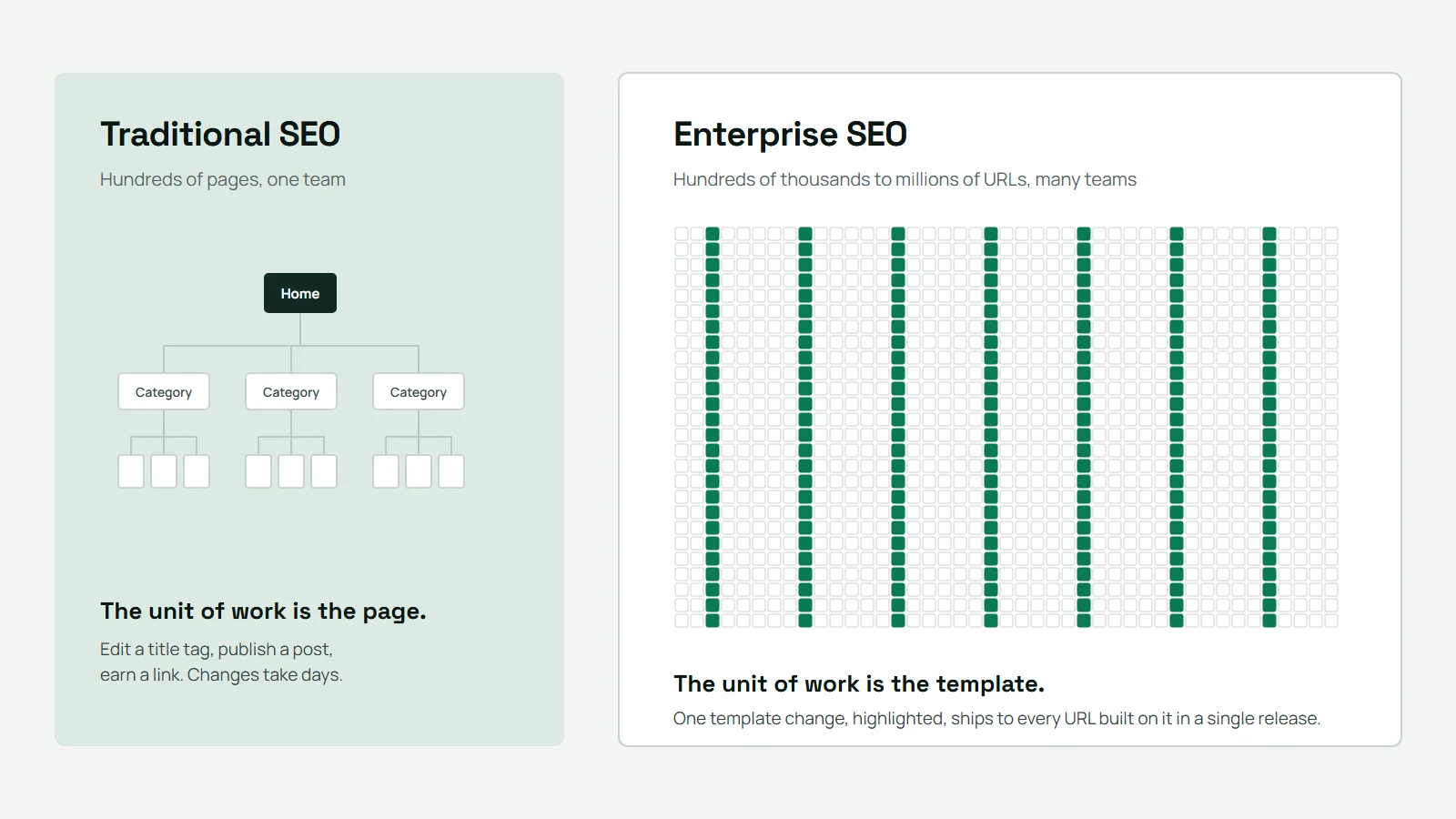
Enterprise SEO vs. traditional SEO
| Dimension | Traditional SEO | Enterprise SEO |
|---|---|---|
| Site size | Dozens to a few thousand pages | Tens of thousands to millions of URLs |
| Main constraint | Content and links | Crawl budget, templates, internal approvals |
| Unit of work | The page | The template, the rule, the release |
| Who implements | One SEO or a small team | Engineering, product, content, legal and regional teams |
| Biggest risk | Slow growth | One deploy deindexing a whole section overnight |
| Success metric | Rankings and sessions | Revenue, pipeline, share of search, index health |
Signs your company needs enterprise level SEO
- Your site has more than 10,000 indexable URLs, or faceted navigation and parameters generate far more than that.
- Several brands, regions or languages share one domain, or compete across several.
- SEO recommendations sit in an engineering backlog for more than a quarter.
- Organic search is a top revenue or pipeline channel, and a ranking drop shows up in board numbers.
- A migration, replatform or headless rebuild is on the roadmap.
If two of these sound familiar, you are already doing enterprise SEO, whether or not anyone is managing it on purpose.
Enterprise SEO services that cover the whole system
Our enterprise SEO services cover technical SEO at scale, enterprise SEO audits, content and entity architecture, internal linking, international SEO, AI search visibility and the governance that keeps gains from slipping. Some clients hire us to run the whole program. Others bring us in for the one layer their in-house team can’t staff.
Enterprise SEO audit
We begin with server logs, a full crawl and Search Console data, and leave tool scores for later. On sites with millions of URLs we crawl by template and sample, then match the crawl against log files to see what Googlebot actually requests. Each finding gets a template, an owner and an estimated revenue impact. You receive a ranked backlog with the engineering tickets already written.
An audit that lists 4,000 issues without saying which twelve matter creates work for your team and little else.
Technical SEO at scale
Enterprise grade SEO starts with crawl budget and JavaScript rendering checks for React, Next.js, Angular and Vue builds. After that come canonical and parameter rules, faceted navigation, pagination, XML sitemap indexes, Core Web Vitals (LCP, INP and CLS) and schema.org structured data. When release cycles are slow, we ship fixes through edge SEO on Cloudflare or Akamai workers instead of waiting for the next deploy.
Content strategy and entity architecture
We build topical maps around how your buyers search, then group content into clusters that cover a subject properly. In practice that means merging cannibalized pages, pruning thin ones and building programmatic templates with real quality controls. Important pages get tied to clear entities like products, categories, locations and people, which helps Google’s Knowledge Graph and large language models describe you accurately.
Internal linking and site architecture
Internal links are the strongest ranking lever a large site fully controls. We model how link equity flows through navigation, breadcrumbs, filters and related-content modules, find orphaned revenue pages and cut click depth for the URLs that convert.
International and multi-brand SEO
Hreflang across dozens of markets, ccTLD or subfolder decisions, regional content governance, and localization that starts with local keyword research before any translation. We also sort out brand portfolios where sister sites compete for the same queries. Brands with many physical locations get a dedicated program through our enterprise local SEO services.
Enterprise SaaS SEO
In SaaS, organic search earns its budget through pipeline. We build integration pages, use-case and industry pages, comparison and alternatives pages, and documentation that ranks, then connect organic sessions to trials, demos and closed revenue in HubSpot or Salesforce. Long sales cycles need attribution that looks past the last click. See our SaaS SEO services for the full approach.
AI search visibility
Optimization for Google AI Overviews and AI Mode, ChatGPT search, Gemini, Perplexity, Claude and Microsoft Copilot. See our enterprise AI SEO services for AEO, GEO and LLMO, or read how AI search works further down this page.
Enterprise SEO management and governance
We write SEO requirements into the release process, add automated pre-deploy checks and regression alerts, assign clear page ownership and train content, product and engineering teams. Reporting goes into the Looker Studio or BigQuery dashboards your leadership already reads.
The Search Infrastructure Model: how we build an enterprise SEO strategy
We plan every enterprise SEO strategy in five layers, and each one depends on the layer below it. Access asks whether crawlers can reach and render the pages. Comprehension asks whether search engines understand them. Connection checks that authority flows to the pages that earn money, credibility checks that the wider web vouches for you, and control keeps the organization from breaking any of it.
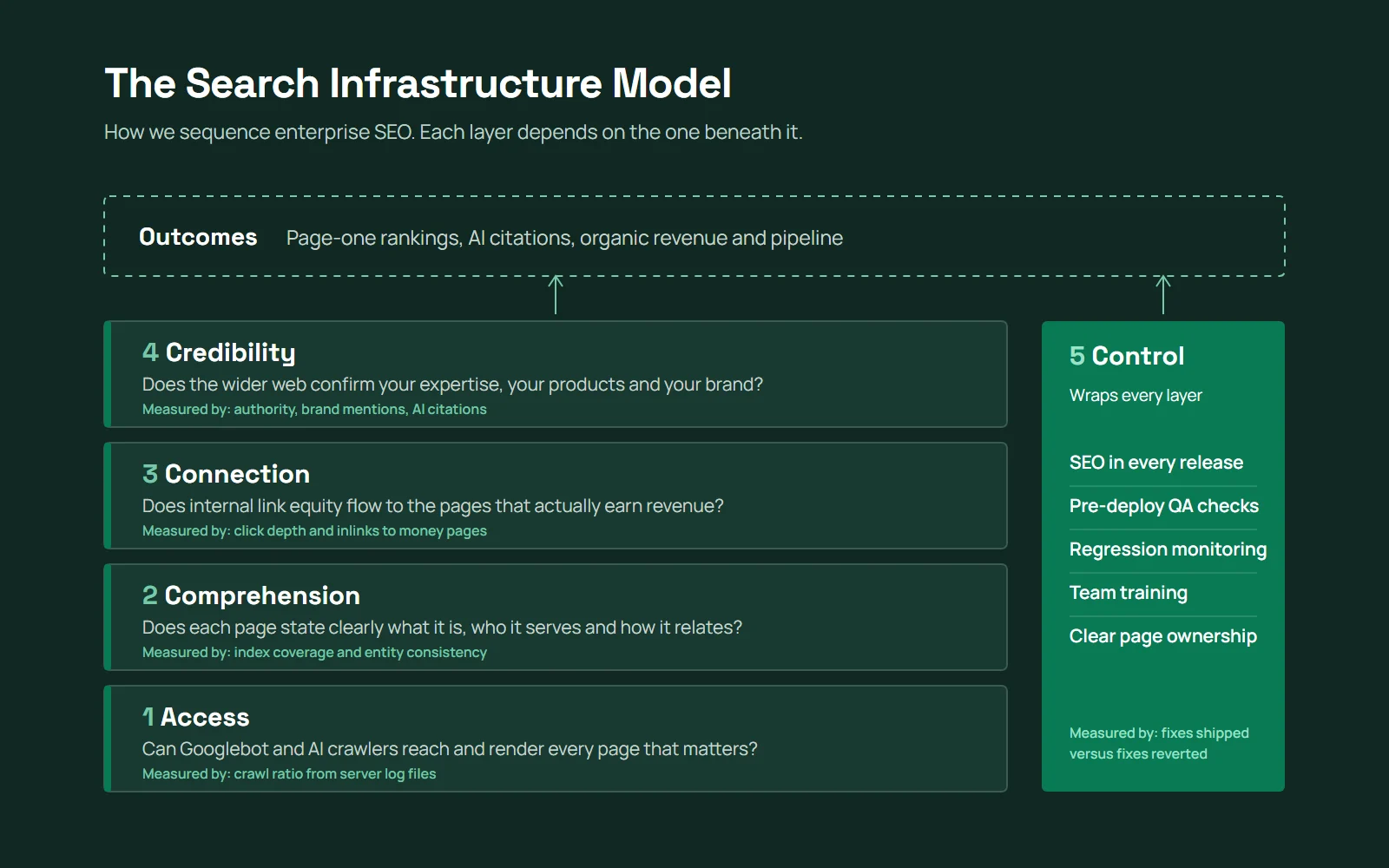
Order matters more than effort. Many of the underperforming programs we inherit spent heavily on content or link building while the access layer leaked. Publishing 300 articles on a site where Google crawls a fifth of the URLs is like pouring water into a cracked glass.
- Access. Log file analysis, rendering tests, robots.txt and CDN bot rules, status codes and redirect chains.
- Comprehension. Templates, titles, headings, structured data, canonical signals and entity consistency.
- Connection. Navigation, breadcrumbs, related-content modules, click depth and orphaned pages.
- Credibility. Digital PR, earned links, brand mentions, reviews and expert authorship.
- Control. Release QA, monitoring, ownership and training. This layer decides whether gains last.
Rankings are an output. Crawl, indexation and internal links are inputs, and inputs are what an enterprise can actually manage.
Enterprise SEO for AI Overviews, ChatGPT, Gemini and Perplexity
AI search engines retrieve before they write. They pull candidate pages from a search index, keep the passages that answer a sub-question cleanly and cite sources they can verify. For an enterprise, AI visibility rests on classic SEO plus extractable passages, consistent entity data across the web and deliberate crawl access for AI user agents.
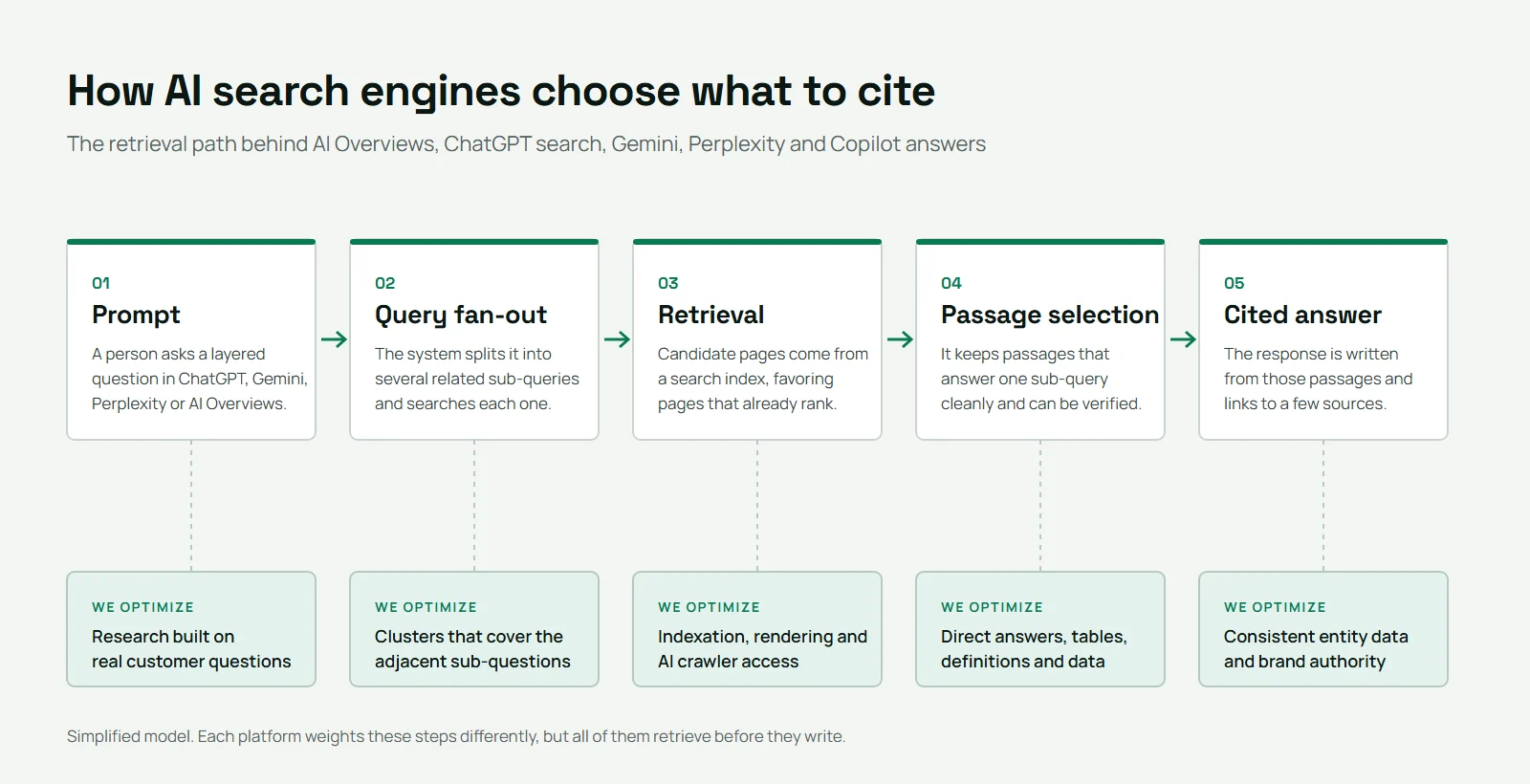
What we see AI systems cite most
- Passages that answer one question in the first two sentences under a clear heading.
- Specific numbers, definitions and named methods in place of adjectives.
- Tables and lists that still make sense when lifted out of the page.
- Brands described the same way on their own site, LinkedIn, Wikipedia and Wikidata, review platforms and industry press.
- Server-rendered HTML. Several AI crawlers do not execute JavaScript, so content loaded client-side can be invisible to them.
A quieter risk sits at the CDN. Providers and security teams sometimes block AI crawlers like OAI-SearchBot, PerplexityBot or ClaudeBot by default, and we would rather that be a business decision made crawler by crawler.
Query fan-out changes content planning
Google AI Mode and ChatGPT search break one prompt into many related searches. A page that also answers the buyer’s next few questions gets more chances to be retrieved than a page built around a single phrase. We plan clusters around those follow-up questions, which is how good SEO content was meant to work all along.
How we measure AI visibility
We track a fixed set of buyer prompts across AI platforms, record citation share against competitors and segment referral traffic from chatgpt.com, perplexity.ai, gemini.google.com and copilot.microsoft.com in GA4. This kind of measurement is younger and noisier than rank tracking, so we report trends over time and tell clients that up front. Our enterprise AEO, GEO and LLMO programs go further into how AI platforms choose sources.
AI search raised the price of being vague.
How an enterprise SEO engagement works
Our enterprise SEO engagements run in five stages: discovery and data access, an audit with an opportunity model, a sequenced roadmap, implementation with your teams, and ongoing measurement and governance. The enterprise SEO experts on your account work inside your tools and sprint cadence, and we re-rank the roadmap every quarter as results come in.
Discovery and access
Analytics, Search Console, server logs, crawl data, the CMS and your deployment workflow. We also interview the people who ship code and content, since that is where most SEO programs stall.
Audit and opportunity model
Issues ranked by revenue impact and effort. Forecasts use your own conversion rates and order or deal values, with every assumption written out.
Roadmap and buy-in
A sequenced plan that fits your sprint cadence, plus the business case each team needs to prioritize SEO work over competing requests.
Implementation
Tickets with acceptance criteria, staging QA, content briefs and release monitoring, inside Jira, Asana or whatever your teams already use.
Measurement and governance
Monthly reporting tied to revenue and pipeline, quarterly strategy resets and automated alerts when a release breaks something.
Try to ship one SEO ticket in the first month, even a small one. Momentum with engineering is worth more than a perfect roadmap that nobody has started.
Enterprise SEO myths we hear in almost every first meeting
Myth
Big brands rank on brand strength alone.
Fact
Brand helps with clicks and links. We still see household names outranked on their own category terms by specialist sites, usually because of thin templates or pages Google never crawls.
Myth
Enterprise SEO is mostly a content problem.
Fact
On sites past roughly 50,000 URLs, technical and architectural fixes tend to move more revenue in the first six months. Content compounds once the foundation stops leaking.
Myth
An enterprise SEO platform replaces an agency.
Fact
BrightEdge, Conductor, seoClarity, Botify and Lumar are excellent at surfacing problems. Getting tickets prioritized, agreeing a canonical strategy with engineering and deciding what to fix first still take people, and no enterprise SEO solution handles that part on its own.
Myth
More pages means more traffic.
Fact
Pruning and consolidating weak pages often lifts total organic traffic, because crawl attention and link equity concentrate on pages worth ranking.
Myth
AI search makes SEO obsolete.
Fact
AI answers are assembled from retrieved web pages, and retrieval leans heavily on search indexes. Strong SEO is how a brand gets into AI citations in the first place.
Six enterprise SEO mistakes that cost the most
Treating a migration as an IT project
Replatforms and redesigns launched without redirect maps, pre-launch crawl benchmarks and post-launch monitoring are the most expensive SEO event we get called in to repair.
Letting faceted navigation run wild
Filter combinations can create millions of indexable URLs that drain crawl budget and split ranking signals across near-duplicates.
Reporting rankings instead of revenue
Leadership funds what it can connect to money. Programs that report positions instead of pipeline lose budget at the first downturn.
Running SEO outside the release process
If SEO checks are not part of QA, the next deploy quietly undoes last quarter’s fixes. We see this more than any other failure.
Translating instead of localizing
Machine-translated pages target words nobody in that market searches for. Local keyword research has to come first.
Blocking AI crawlers by accident
Default bot rules at the CDN can remove you from AI answers without anyone deciding to. Someone on the business side should own that call.
How to choose the best enterprise SEO agency
Choose an enterprise SEO company on evidence that it works at your scale. Look for experience with sites of your size and stack, an audit method built on logs and real data, engineering-ready tickets, forecasts with stated assumptions and reporting tied to revenue. Then check that the senior people from the pitch will do the work, and ask to see a redacted roadmap from a similar client.
Questions to ask enterprise SEO firms before you sign
- Which sites of our size and platform have you worked on, and what broke?
- Can we see a redacted audit and the tickets that came out of it?
- Who exactly will work on our account once the contract is signed?
- How do you forecast, and which assumptions sit behind the numbers?
- How do you fit into our engineering team’s sprint process?
- How do you measure AI search visibility today?
Pay close attention to the second answer. An enterprise SEO firm that can only show you slides will probably hand you more slides. The top enterprise SEO services prove themselves in what ships.
Agency, in-house team or enterprise SEO consultant?
| Option | Best for | Watch out for |
|---|---|---|
| Enterprise SEO agency | Programs that need technical, content, digital PR and analytics skills at once, with patterns learned across many large sites | Junior staff after the sale. Ask who does the work. |
| In-house SEO team | Steady long-term needs, deep product knowledge and internal relationships | Hard to hire every specialty. Teams can lose sight of wider industry patterns. |
| Independent enterprise SEO consultant | Strategy, migrations and second opinions from one senior expert | Limited capacity for hands-on implementation. |
The strongest setup we see is an in-house SEO lead with an agency acting as the extended bench, which is how we work with in-house teams. Each covers what the other cannot, and neither works as well alone.
Enterprise SEO pricing and packages, explained
Our enterprise SEO packages start from $5,000 per month. Where a program lands above that depends on site size and complexity, the number of markets and brands, how much implementation we carry versus your engineers, and content volume. Ongoing work runs as a monthly retainer scoped after an audit, while standalone audits and migrations are usually fixed projects.
What drives the cost
- URL count and the number of distinct templates
- Platforms involved, from custom builds and headless CMS setups to Adobe Experience Manager, Salesforce Commerce Cloud or Shopify Plus
- Markets, languages and brands in scope
- Implementation support versus advisory only
- Content production volume and subject-matter review
- Reporting and data engineering needs
The $5,000 starting point covers a focused program. A two-million-URL site with three content management systems needs a scope built from its own data, so we price larger programs after we have looked at your logs and templates.
Ways to work with us
Enterprise SEO audit
Fixed-scope project. A full technical, content and authority review with a prioritized, ticket-ready roadmap.
Migration and replatform support
Fixed project from planning and redirect mapping through post-launch monitoring.
Ongoing enterprise SEO program
Monthly retainer covering strategy, implementation support, content and reporting, starting from $5,000 per month.
Advisory and consulting
Senior consultant time for in-house teams that need direction more than extra hands.
TL;DR
- Enterprise SEO is SEO for large, complex sites, where most changes happen through templates and releases.
- Sequence matters. Fix access and comprehension before you scale content and links.
- AI search engines cite pages they can retrieve, parse and verify, so classic SEO is the base of AI visibility.
- Gains last only when SEO checks sit inside the release process.
- Judge enterprise SEO companies by their tickets, their forecasting assumptions and who actually does the work.
- Our enterprise SEO packages start from $5,000 per month.
Enterprise SEO FAQs
What is enterprise SEO?
Enterprise SEO is search engine optimization for large organizations with complex websites, usually tens of thousands to millions of URLs managed by several teams, brands or markets. It covers technical SEO for very large sites, content architecture, internal linking, governance and reporting tied to revenue, with most changes shipped through templates and release cycles.
How is enterprise SEO different from regular SEO?
Regular SEO works page by page with one person or a small team. Enterprise SEO changes templates that control thousands of pages, so it depends on engineering, product, legal and regional teams agreeing and shipping. The risks are bigger, since one bad deploy can deindex a whole section, and success is measured in revenue, pipeline and index health.
How much does enterprise SEO cost?
Our enterprise SEO packages start from $5,000 per month. Larger programs cost more depending on site size, the number of markets and brands, how much implementation we take on and content volume. Standalone audits and migrations are usually priced as fixed projects, and we scope every program after looking at your data.
How long does enterprise SEO take to show results?
Technical fixes on large sites often change crawling and indexation within weeks of release, and traffic follows over the next two to four months. Content and authority work builds over six to twelve months. Release speed is the usual bottleneck, because a fix that waits two quarters in a backlog delivers nothing for those two quarters.
What does an enterprise SEO audit include?
A proper enterprise SEO audit combines a full or template-sampled crawl, server log analysis, Search Console and analytics data, rendering tests, internal link modeling, a content and cannibalization review, structured data validation and an authority assessment. You should come away with a prioritized backlog, impact estimates and tickets engineers can pick up, rather than a list of tool warnings.
How do you choose an enterprise SEO agency?
Look for experience with sites of your size and platform, audits built on log files and real data, tickets your engineers can use, forecasts that show their assumptions and reporting tied to revenue. Ask who will work on your account after the contract is signed, and ask to see a redacted audit or roadmap from a similar client.
Do you work with in-house SEO teams?
Yes, and it is often the strongest setup. We share one roadmap with your SEO lead, file tickets in your tools, join sprint planning and train content and product teams. If you have no in-house SEO yet, we can run the program end to end until you hire one.
How do you measure ROI from enterprise SEO?
We connect non-brand organic traffic to revenue or pipeline using your analytics and CRM data, compare results with a pre-engagement baseline and forecast, and divide the incremental value by total program cost. Across our client engagements the average return has been 4.7x. Individual results depend on market, site condition and how quickly fixes ship.
Does enterprise SEO help with AI Overviews and ChatGPT?
Yes, though nobody can guarantee a citation. AI Overviews, ChatGPT search and Perplexity draw on pages that are indexed, open to their crawlers and easy to quote. Direct-answer content, structured data, consistent entity information across the web and digital PR that earns mentions on trusted sources all improve the odds.
Enterprise SEO is an operating discipline
Large websites rarely fail at SEO for lack of ideas. Good ideas fail to ship, or ship and then quietly get undone. Since 2012, our work as an enterprise SEO marketing company has been building the systems, priorities and working relationships that let big teams ship SEO improvements and keep them.
If organic search matters to your revenue and your site is too big to manage by hand, tell us about it. A senior strategist will review your site and goals and come back with the biggest opportunities we see.
Request a Free Quote
Tell us about your site and goals. We reply within one business day.